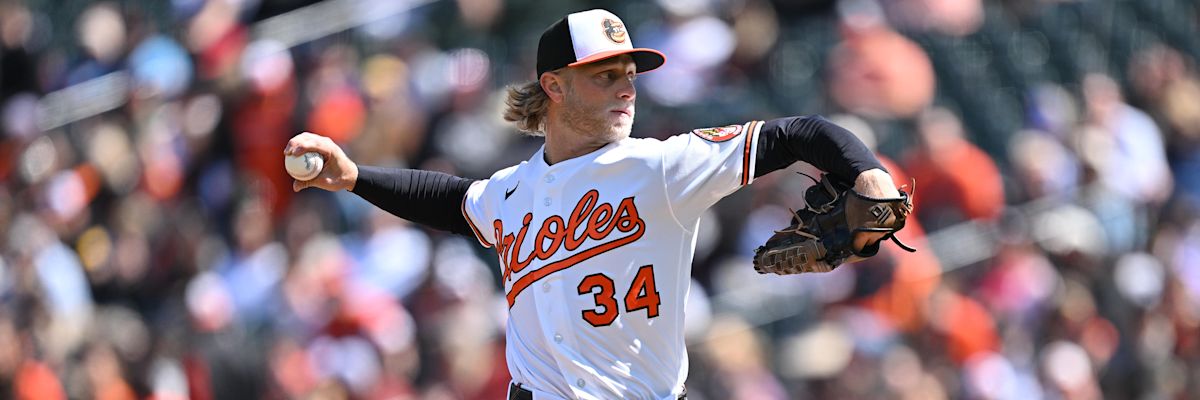
Baz has thrown 16, 17, 15, and 18 outs across his first four 2026 starts. The under at 17.5 has cashed in three of four with the only over coming on a 99-pitch grind against Cleveland. Houston is a contact-oriented lineup at 24.9% K rate that does not chase, the kind of patient AL West offense that drives pitch counts up and shortens outings.
Shane Baz has thrown 4 starts in 2026 entering this one. He has averaged 5.5 innings per outing on 94 pitches per start. That's the structural floor and ceiling we are working with. The line tonight asks for more than 5.83 innings of work, and his actual pace puts him below that mark.
The under has cashed in 3 of 4 starts so far and the over has cashed in 1. That is the directly observable rate this season. The model takes that observable rate, blends it against league baselines and the matchup, and lands at a 75.1% under probability against a market-implied 51.0%. The gap is the edge.
For 2025 context, Shane Baz threw 166.3 innings with a 9.52 K/9 and 4.87 ERA across 31 appearances. That's the longer baseline the market is anchoring to. The 2026 sample is what's actively repricing.
Here's exactly what each 2026 outing has looked like. The right-most column is outs recorded against tonight's line of 17.5.
| Date | Opponent | IP | K | BB | ER | Pitches | Outs |
|---|---|---|---|---|---|---|---|
| Mar 29 | vs Minnesota Twins | 5.1 | 4 | 0 | 4 | 78 | 16 |
| Apr 04 | at Pittsburgh Pirates | 5.2 | 5 | 3 | 1 | 98 | 17 |
| Apr 10 | vs San Francisco Giants | 5.0 | 4 | 2 | 3 | 99 | 15 |
| Apr 16 | at Cleveland Guardians | 6.0 | 6 | 3 | 4 | 99 | 18 |
Shane Baz has cleared 17.5 outs in 1 of 4 2026 starts. He has finished under in 3 starts. The 2026 average outs total is 16.5 versus the line of 17.5, which is the structural argument behind the model's 75.1% under read.
The Houston Astros carry a 18.9% strikeout rate as a 2026 team batting unit. A contact-oriented lineup forces the starter to throw extra pitches per at-bat and can shorten his outing because he runs out of pitches before he runs out of outs. That favors the under on outs.
Pair that contact tendency with the structural pitch-count cap above and the under leans heavier than the line implies.
Every prop has risks. Here's the honest other side.
The case against is real. The case for is the observed pattern: through 4 starts in 2026, the under has been the right side at this line more often than the market is currently paying you to take it.
This is a workload-driven under. The market is pricing it largely off historical innings-pitched expectations for a starter, but the 2026 usage pattern has created a structural cap that has not yet been broken. The model gives the under a 75.1% probability and the no-vig market price implies 51.0%. The edge is 24.1% in expected value terms, which puts the play at +37.6% EV.
You're getting paid to take a side that has cashed at a higher rate than the line is pricing for. As long as the workload-management plan stays intact, the under is the right side here.
Model probability 75.1% vs no-vig market probability 51.0%. Implied EV +37.6% EV at -120 DraftKings. Sample n=4-5 in 2026, so size accordingly.