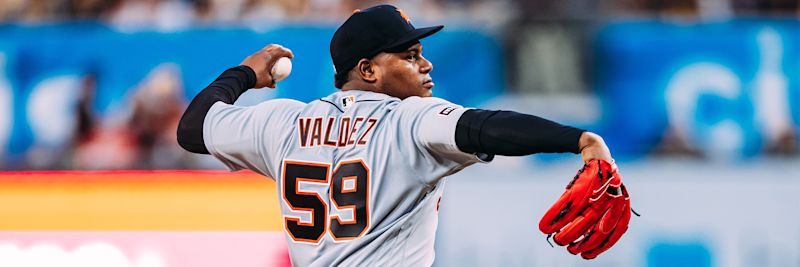
Valdez signed a 3-year, $115 million deal with Detroit this offseason, and his first two starts have been stellar: 12 innings pitched, just 1 earned run, a 0.75 ERA. But here's the thing people are missing. The 10 strikeouts in 12 IP have inflated his early K rate to 7.5 K/9, and the books have set his line at 5.5. That's a trap. Valdez is a career groundball pitcher with an 8.0 K/9. His game isn't about racking up punchouts. It's about getting hitters to beat the ball into the dirt. His sinker and curveball generate weak contact at elite rates. At -113 on the under, you're getting a reasonable price on a pitcher who is far more likely to go 6-7 innings with 4-5 strikeouts than to fan 6 or more.


Let's get one thing straight about who Framber Valdez is as a pitcher. He's not Corbin Burnes. He's not Tarik Skubal. He's not a guy who's going to blow 98 past hitters and pile up 10-12 strikeouts every time he takes the mound. That's never been his game, and it's never going to be his game. What Valdez does, better than almost anyone in baseball, is make hitters put the ball on the ground. His sinker dives into right-handed batters' hands and produces some of the weakest contact in the sport. His curveball drops off the table and generates rollovers to the shortstop side. It's a beautiful, efficient, pitch-to-contact identity that keeps him deep in games without needing to miss bats at an elite rate.
Valdez's career K/9 sits around 8.0. That's perfectly fine. It's above league average. But it's not the profile of a pitcher who consistently clears 5.5 strikeouts with ease. An 8.0 K/9 pitcher going 6 innings would project for about 5.3 strikeouts. Going 7 innings? About 6.2. That means in a typical Valdez start where he goes 6-7 innings, he's sitting right on the knife's edge of this 5.5 line, and his natural tendency is to land on the under side. His game plan isn't "get two strikes and put hitters away." It's "get a sinker in on their hands, let them ground it to second base, and move on."
Framber Valdez is one of the premier groundball pitchers in baseball. His career groundball rate exceeds 55%, which puts him in elite company among active starters. For context, the league average groundball rate hovers around 43%. That 12+ percentage point gap above average isn't an accident. It's the direct result of a sinker/curveball combination designed to induce weak contact and keep the ball on the ground. Every groundball is a ball that wasn't struck out. Valdez doesn't need to miss bats to dominate. He needs hitters to make bad contact, and they do it constantly.
Detroit signed Valdez to that 3-year, $115 million contract because they knew exactly what they were getting. Not a flashy strikeout artist, but one of the most reliable, durable arms in the sport. A guy who eats innings, keeps the ball on the ground, and limits hard contact. That's incredibly valuable. But it also means his strikeout ceiling is lower than the market sometimes prices in, especially when a hot start inflates his early-season K numbers.
Here's where this gets interesting. Valdez has 10 strikeouts in 12 innings through his first two starts of 2026. That's a 7.5 K/9 pace, which is actually slightly below his career average of 8.0. But the 10 total in two starts has created the perception that he's racking up punchouts, and the books have set his line at 5.5 with the over at -107 and the under at -113. That pricing tells you the market is basically split, leaning ever so slightly toward the over.
| Metric | Career | 2026 (Early) | Projection |
|---|---|---|---|
| K/9 | ~8.0 | 7.5 | Supports Under |
| K per 6 IP | ~5.3 | 5.0 | Under 5.5 |
| K per 7 IP | ~6.2 | 5.8 | Borderline |
| Groundball Rate | 55%+ | 55%+ | Elite |
| BB/9 (2026) | -- | 2.25 | Neutral |
Look at those numbers. If Valdez goes 6 innings tonight, which is his most common outing length, his career rate projects him for roughly 5.3 strikeouts. That's under 5.5. He'd need to go a full 7 innings at his career K rate just to get to 6.2, which barely clears the line. And here's the thing about groundball pitchers: they tend to work efficiently through the order. Valdez isn't a guy who's running up 20-pitch at-bats trying to punch guys out. He's getting quick, soft contact and moving through the lineup. That efficiency means shorter at-bats, fewer two-strike counts, and fewer strikeout opportunities.
The over at -107 tells you the books expect this to be close. But "close" with a groundball pitcher favors the under. When Valdez is at his best, he's not striking guys out, he's getting them to ground into double plays and fly out to center on the first or second pitch of the at-bat. His most dominant outings are often the ones with the fewest strikeouts, because he's inducing so much weak contact that hitters can't even foul pitches off long enough to reach strikeout counts. The 10 K in 12 IP is the small sample that's juicing this line. His career says 5.3 K per 6 innings. Trust the career.
This is an important distinction that a lot of bettors miss. When you bet Valdez's earned runs under, you're betting on overall dominance. You need him to be unhittable, to strand runners, to limit damage. Strikeout unders are different. You're betting on a specific outcome within his dominance. And for Valdez, the specific outcome is weak contact, not whiffs.
Think about it this way: Valdez can absolutely go 7 innings tonight, allow 0 earned runs, and only strike out 4 hitters. That would be a phenomenal start by any measure. He'd have dominated Minnesota's lineup. But he'd have done it his way, with groundball after groundball, double play after double play, routine fly ball after routine fly ball. The scorecard would show dominance. The K column would show 4. And your under would cash.
That bar chart makes the gap obvious. Valdez generates groundballs at a rate that's 12+ percentage points above the MLB average. For every ball that a league-average pitcher gets hit in the air or whiffed on, Valdez is getting it bounced into the dirt. Every one of those groundballs is a ball that wasn't a strikeout. It's the fundamental tradeoff of his pitching style: fewer strikeouts, but more outs on fewer pitches. That's why his inning counts are always high and his pitch counts are always manageable. He's not grinding through 6-7 pitch at-bats. He's getting results on pitch two or three.
Groundball pitchers are inherently strikeout-under pitchers. When a pitcher's entire game plan revolves around inducing contact, they're naturally limiting their strikeout opportunities. Valdez doesn't nibble at the edges of the zone trying to get hitters to chase. He attacks with his sinker, gets weak contact, and moves on. His pitch economy is excellent because of this approach. He regularly throws 90-100 pitches through 6-7 innings, which means he's averaging around 14 pitches per inning. That's incredibly efficient, and efficient innings mean fewer two-strike counts, which means fewer strikeouts.
Every honest analysis has to address the other side. Here's what could go wrong with this under play.
The Minnesota vs LHP angle is the most legitimate risk. A lineup that can't square up a lefty sinker might produce a lot of whiffs instead of a lot of groundballs. That said, Valdez's sinker is specifically designed to induce contact, not generate swings and misses. Even overmatched hitters tend to put the bat on Valdez's sinker. They just can't do anything productive with it. The 3 walks in 12 IP suggest he's attacking the zone aggressively and trusting his stuff, which is consistent with a contact-over-strikeouts approach.
This comes down to a simple question: do you trust a pitcher's career identity or two starts of data? Framber Valdez has been a groundball-first, contact-inducing pitcher for his entire career. His 55%+ groundball rate, his career 8.0 K/9, his sinker/curveball combination, everything about his profile screams "I get outs without needing to strike you out." The 10 K in 12 IP to start 2026 is a small sample that's inflating this line to 5.5, and the market is basically split with the over at -107 and the under at -113.
At -113 odds, you need this to hit about 53% of the time to break even. Given Valdez's career profile, that's comfortably achievable. His career K/9 of 8.0 projects to roughly 5.3 strikeouts in a 6-inning outing, which is under 5.5. He'd need to go a full 7 innings at his career rate just to reach 6.2 strikeouts. The groundball rate above 55% means he's actively turning potential strikeouts into soft contact. The -113 juice is very reasonable for a pitcher whose entire identity supports the under. You're not paying steep juice. You're getting a fair price on a high-probability outcome that aligns with everything Valdez does on the mound.
Valdez doesn't need to have a bad night for this under to hit. He just needs to be himself. Throw sinkers that dive into barrels and produce rollers to second base. Drop curveballs that generate weak grounders to short. Work efficiently through the Minnesota lineup, keep the pitch count manageable, and let his defense do the work. Four or five strikeouts in 6-7 dominant innings is the most likely outcome tonight. That's a vintage Valdez start. That's exactly who he's always been. And that's an under.