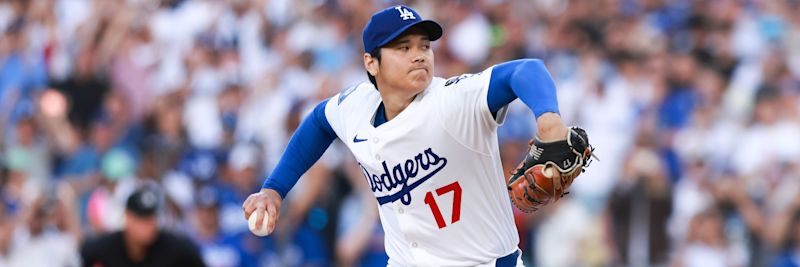
Ohtani is punishing baseballs at a 96.4 mph average exit velocity with a 19.2% barrel rate that sits in the 99th percentile. Tonight he faces Jon Gray, whose slider location against left-handed hitters has been a documented liability all season. Globe Life Field is carrying hot right now with a +12% carry metric. The simulation says 61.8% hit rate on the over, versus 55.5% implied at -125. That is a 6.3% edge, and the batted-ball data backs it up.


Let's start with what makes Ohtani different from virtually every other hitter in baseball right now. His 96.4 mph average exit velocity is not just good, it is elite. It is generational. When Ohtani puts a ball in play, the expected outcome is fundamentally different from any other hitter on tonight's board, because the ball is leaving his bat harder than nearly anyone in the sport.
The 19.2% barrel rate puts him in the 99th percentile among qualified hitters. That means roughly one out of every five balls he puts in play is a barrel, which Statcast defines as a batted ball with the optimal combination of exit velocity and launch angle to produce a batting average of .500 or higher and a slugging percentage of 1.500 or higher. Those are extra-base hit machines. When Ohtani barrels a ball, it does not result in a single very often. It results in a double off the wall, a home run, or a screaming line drive into the gap.
His 58.4% hard hit rate reinforces the picture. More than half of his batted balls are classified as hard contact. For total bases purposes, that is the number that matters most, because hard contact correlates directly with extra-base hits. A hitter who makes soft contact might still collect singles through the infield, but a hitter who drives the ball with authority is producing doubles, triples, and home runs at a significantly higher clip. Ohtani's batted-ball data says he is producing high-quality contact at an extraordinary rate, and that quality of contact is the foundation for tonight's total bases play.
Total bases reward authority, not frequency. A hitter can go 1-for-4 with a home run and clear the over at 1.5 total bases. Ohtani's barrel rate and exit velocity profile mean that when he connects, the outcome skews toward doubles and home runs rather than ground ball singles. That extra-base hit upside is what separates this play from a generic "will he get a hit" prop. Even one solid connection can cash this ticket.
Jon Gray is a competent major league starter with a repertoire built around a four-seam fastball, slider, and curveball. Against right-handed hitters, Gray's slider is his primary weapon for generating chases and swing-and-miss. Against left-handed hitters, that pitch becomes a problem, because the slider's natural movement pattern takes it toward the heart of the left-handed batter's zone rather than tunneling away from it.
This is not a new development. Gray's career splits against lefties have consistently shown elevated hard-hit rates and higher slugging percentages compared to his numbers against right-handed hitters. The slider that buckles righties at the knees tends to back up and catch the inner third against lefties, and when a left-handed hitter with Ohtani's exit velocity gets a slider on the inner half, the damage is substantial. That pitch becomes a mistake rather than a weapon.
Gray's early 2026 numbers have not done anything to dispel the pattern. His ERA sits north of 4.50, and left-handed hitters specifically have been finding hard contact against him. The fastball still plays up in the zone, and Gray can certainly get Ohtani out on any given pitch. But the probabilities favor Ohtani making loud contact at least once across 3-4 plate appearances, and loud contact from Ohtani almost always produces extra bases.
Gray's slider against LHH is the single biggest reason this prop is actionable. The pitch backs up into the zone instead of sweeping away from lefties, and Ohtani is among the best in the sport at punishing mistakes on the inner half. One mislocated slider in a 3-4 PA game is all it takes.
The numbers across the board tell the same story. Here is how Ohtani stacks up against the rest of the league in key batted-ball metrics.
| Metric | Ohtani (2026) | MLB Avg | Percentile |
|---|---|---|---|
| Avg Exit Velocity | 96.4 mph | 88.2 mph | 99th |
| Barrel Rate | 19.2% | 7.8% | 99th |
| Hard Hit Rate | 58.4% | 36.2% | 97th |
| Max Exit Velocity | 118.2 mph | 109.5 mph | 99th |
| xSLG | .612 | .389 | 98th |
Everything in this table points to the same conclusion: Ohtani is not just hitting the ball hard, he is hitting it harder than almost everyone else in baseball, and that hard contact is translating into expected slugging numbers that project significantly above league average. The .612 xSLG is particularly relevant for total bases props, because expected slugging percentage directly models the rate at which a hitter produces total bases per at-bat. An xSLG that high does not just support the over at 1.5, it suggests that the line could reasonably be set higher.
Globe Life Field in Arlington has been carrying hot in the early going this season, with a reported +12% carry metric compared to a neutral park. That is significant. The retractable roof stadium has always played as a hitter-friendly environment for fly balls, and early-season atmospheric conditions in Texas tend to favor the ball carrying to the outfield corners and over the walls.
For a hitter like Ohtani, who generates elite-level exit velocity and consistently elevates the ball, a ballpark that is carrying hot adds incremental value on fly balls that might die at the warning track in a less favorable environment. A fly ball that gets out at 105 mph and a 28-degree launch angle might be a long fly out at Oracle Park in San Francisco. At Globe Life with a +12% carry metric, that same batted ball finds the seats or rattles off the wall for extra bases.
The park factor compounds the matchup advantage. Ohtani's barrel rate generates the launch conditions, Gray's slider vulnerability creates the pitch to punish, and Globe Life's carry conditions mean the damage goes farther. All three variables are pointed in the same direction, and when multiple independent factors align like that, the expected outcome shifts more dramatically than any single factor alone would suggest.
Running Ohtani's batted-ball profile against Gray's pitch mix and location tendencies through a Monte Carlo simulation produces a 61.8% probability that Ohtani finishes with 2 or more total bases tonight. The DraftKings line of -125 implies a 55.5% probability. That is a 6.3% edge, which is a meaningful gap in prop markets where 3-4% edges are considered actionable.
The simulation accounts for multiple pathways to clearing the over. Ohtani does not need a home run. A double clears it. Two singles clear it. A single and a double, a triple, any combination of base hits that adds up to 2 or more total bases. Given that Ohtani's contact quality produces extra-base hits at an above-average clip, the number of paths to the over is wider than it would be for a contact-first singles hitter at the same line.
Simulation hit rate: 61.8%. Implied probability at -125: 55.5%. Edge: 6.3%. Three independent factors converge tonight: Ohtani's 99th-percentile batted-ball authority, Gray's slider vulnerability against left-handed hitters, and Globe Life Field's +12% carry metric. When three uncorrelated variables all favor the same side, the compounding effect creates a wider edge than any single factor alone. This is a spot where the data, the matchup, and the environment all point the same direction.
All valid concerns. None of them override the central thesis. Ohtani's batted-ball quality is not a small-sample artifact. His exit velocity and barrel rate have been elite for three consecutive seasons. The matchup advantage against a slider-heavy right-hander is structural, not situational. And the ballpark factor, while potentially noisy in small samples, only adds to what is already a strong case. The edge is real, and 1 unit is the right sizing for this level of confidence.