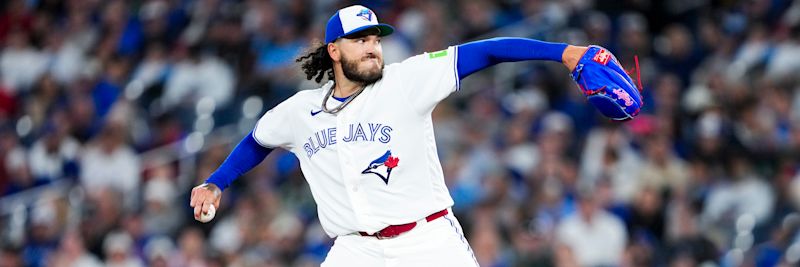
The most dominant pitcher in KBO history takes the Rogers Centre mound for the first time. Ponce's 252 strikeouts shattered a league record, his spring training was filthy, and the Rockies strike out more than almost any team in baseball on the road. Over 5.5 K's at -108 is a bargain.


This is not your typical KBO import. Forget every cautionary tale you've heard about Korean league pitchers struggling to make the jump, because Cody Ponce didn't just succeed in the KBO. He rewrote the record books, set them on fire, and walked away with the MVP trophy.
In 2025, Ponce posted a 17-1 record with a 1.89 ERA across 180.2 innings. Those are absurd numbers on their own. But the strikeout totals are what make this prop play so compelling. Ponce racked up 252 strikeouts, shattering the KBO single-season record that had stood at 225. He didn't just edge past the old mark. He obliterated it by 27 strikeouts, a gap that speaks to just how far above the competition he was operating. For context, that's a 12.55 K/9 rate in a league where hitters are aggressive and make contact at higher rates than their MLB counterparts.
Ponce set the KBO record with 18 strikeouts in a single 9-inning game. That's not a fluky performance against a bad lineup. That's a pitcher whose stuff is so good that professional hitters simply cannot make contact when he's at his best. The question isn't whether Ponce can miss bats. It's whether the adjustment to MLB-caliber lineups slows down a strikeout machine that was untouchable in Asia.
What separates Ponce from the typical KBO-to-MLB conversion is the contract Toronto handed him. The Blue Jays signed him to a 3-year, $30 million deal, which doubled the largest KBO-to-MLB contract in history. Front offices don't commit that kind of money on a whim. Toronto's analytics department saw something in Ponce's pitch data, spin rates, and swing-and-miss metrics that convinced them his stuff would play at the highest level. When a front office that aggressive on pitching development makes Ponce the most expensive KBO import ever, you pay attention.
He's also an American-born pitcher who played in the Pirates system before heading to Korea, so the cultural adjustment factor that sometimes hampers international imports is essentially nonexistent. This is a guy who knows MLB clubhouses, understands the travel, and has faced affiliated hitters before. He went to Korea to rebuild his career, and he came back as the best pitcher in that league's history.
Colorado's offense has a well-documented split problem, and it gets worse every year. At Coors Field, the thin air inflates everything. Away from it, the Rockies look like one of the most overmatched lineups in baseball. The 2025 numbers tell the story clearly: Colorado posted a league-worst .260 wOBA on the road, the kind of number that screams "this lineup can't hit outside of elevation."
| Stat | Value | Context |
|---|---|---|
| K Rate vs RHP (2025) | 26.4% | 2nd-highest in MLB |
| Road wOBA (2025) | .260 | League-worst |
| Road K Rate (2025) | 28.6% | Elevated away from Coors |
| 2026 Record | 0-3 | Lost 3 straight to start the season |
That 26.4% strikeout rate against right-handed pitching is the number that matters most for this prop. More than one in four plate appearances against a righty last season ended in a strikeout. And that number inflates on the road, where Colorado struck out at a 28.6% clip. When you take a lineup that already struggles to make contact against right-handers and transport them to a sea-level ballpark where the ball breaks harder and moves faster, everything gets worse for the hitters.
The Rockies are 0-3 to start 2026, having lost three straight. Early-season Colorado road trips are historically brutal because the hitters spend spring training at altitude, then immediately have to recalibrate their eyes and timing for ballparks where pitches don't flatten out. A pitcher with genuine swing-and-miss stuff, like Ponce, is exactly the type of arm that exploits this adjustment window.
Rogers Centre is a pitcher-neutral environment at sea level. Every breaking ball Ponce throws will have more bite than what Colorado hitters are accustomed to seeing. Every changeup will have more depth. Every fastball will hold its plane better. The physics of pitching work against the Rockies every time they leave Denver, and today they're facing a pitcher with elite spin rates and a devastating changeup. This is a matchup that should produce strikeouts in volume.
Spring training stats are always taken with a grain of salt, but when a pitcher coming from a foreign league puts up the kind of numbers Ponce did this spring, you sit up and take notice. In 13.2 innings, Ponce posted a 0.66 ERA with a 0.81 WHIP while striking out 12 against just 4 walks. That's a 24% strikeout rate against a mix of MLB regulars and top prospects, which is right in line with above-average MLB starters.
| Stat | Value | Context |
|---|---|---|
| ERA | 0.66 | Dominant run prevention |
| WHIP | 0.81 | Sub-1.00, elite control |
| K/BB | 12/4 | 3.0 K/BB ratio |
| K Rate | 24% | Strong swing-and-miss |
| IP | 13.2 | Built up for regular season |
The most encouraging data point from spring training wasn't the ERA or the strikeout numbers. It was the spin rate data. Ponce's fastball spin rate matches elite MLB levels, which means his four-seamer gets the same kind of carry and late life as pitchers who routinely rack up 6+ strikeout games. Pair that with a devastating changeup that generated whiffs consistently against major league hitters, and you have a pitch mix that translates. The tools are there. The question is whether he can sustain it over a full start against a big league lineup.
That 0.81 WHIP in spring is noteworthy because it mirrors his KBO profile. Ponce doesn't just strike guys out. He keeps runners off base by pitching efficiently and staying ahead in counts. When a pitcher works ahead, he gets to use his putaway pitches in advantageous counts. When those putaway pitches include a changeup that had KBO hitters looking foolish for an entire season, the strikeouts follow naturally. The transition from KBO to MLB always carries uncertainty, but Ponce didn't show a single crack in his armor this spring.
Let's be clear about what we don't know. This is a debut start, and debut starts come with genuine uncertainty that no amount of data can fully eliminate.
The risk factors are real, but they're already priced into the line. At -108, you're getting essentially even money on a pitcher with a record-breaking strikeout pedigree against one of the most K-prone lineups in baseball on the road. The books are pricing in the debut uncertainty. We think the matchup-specific factors, particularly Colorado's 26.4% K rate vs RHP and their road wOBA of .260, tip the scale firmly in favor of the over.
Everything about this matchup screams strikeouts. You've got a pitcher who set the KBO single-season strikeout record with 252 K's in 180.2 innings, validated his stuff against MLB hitters all spring with a 0.66 ERA and 24% strikeout rate, and now faces a Colorado lineup that struck out at a 26.4% clip against right-handed pitching last season. The Rockies are 0-3, they're playing at sea level where breaking balls bite harder, and their road wOBA was the worst in baseball.
At -108, you need this to hit roughly 52% of the time to break even. Given Ponce's KBO K rate of 12.55 per 9 innings, even a significant regression to something like 8-9 K/9 against MLB hitters would project to 5-6 strikeouts in a standard outing. Against the Rockies specifically, with their elevated road K rate and tendency to expand the zone against pitchers they've never seen, we believe the true probability of 6+ strikeouts is closer to 60%. The price is right, and the matchup is elite.
The debut uncertainty is the only thing keeping the books from pricing this at -150 or steeper. That uncertainty is your edge. The market is giving you close to even money on a generational KBO talent facing one of the worst road-hitting teams in baseball. Don't overthink it.