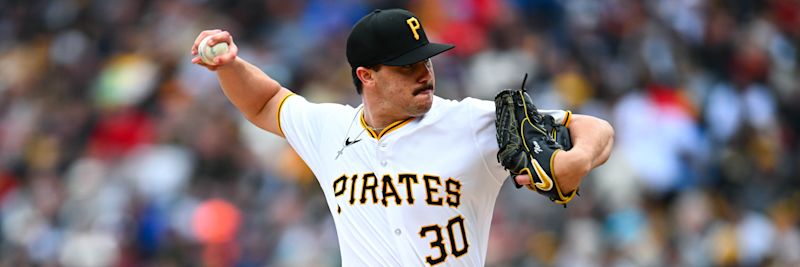
Skenes is not a normal pitcher. His four-seam fastball averages 100.2 mph with a -4.1 degree vertical approach angle, his extension ranks in the 99th percentile, and his splinker generates whiff rates that most starters cannot touch. The Cubs strike out at 26.2% against right-handed pitching, 4th highest in baseball. At -115, the book is barely charging juice on a line Skenes has cleared in the majority of his career starts. This is a structural mismatch.


Let's start with what makes Paul Skenes different from every other pitcher on any MLB mound tonight. His four-seam fastball averages 100.2 mph. That alone would be enough to generate above-average swinging strike numbers. But velocity is only half the story. Skenes throws that fastball with a vertical approach angle of -4.1 degrees, which is among the flattest in all of baseball. A flat VAA at triple-digit velocity means hitters are swinging under the ball constantly, because the pitch does not drop as much as their timing expects it to. The ball arrives faster than they read it and stays on a plane that their bat path cannot intercept cleanly.
Then there is the extension. Skenes releases the ball at 99th percentile extension, meaning his effective perceived velocity is even higher than his actual radar gun reading. A 100 mph fastball with elite extension arrives at the plate like a 102-103 mph pitch from a pitcher with average release distance. Hitters have roughly 400 milliseconds to decide whether to swing, and Skenes is shaving 15-20 milliseconds off that window through sheer physical mechanics. That is the difference between fouling a pitch off and swinging through air.
The combination of velocity, approach angle, and extension is not something hitters can adjust to mid-game. This is not a pitcher who relies on deception or sequencing to get whiffs. The fastball is physically difficult to hit. It is a mechanical advantage, not a strategic one, and mechanical advantages do not disappear when a lineup sees a guy for the second or third time through the order.
100.2 mph + -4.1° VAA + 99th percentile extension = a fastball that is structurally difficult to make contact with. This is not about pitch mix or location. The four-seam itself generates whiffs at an elite rate purely through physical properties. Hitters cannot time it, and they cannot adjust to it within a single game.
If the fastball were all Skenes had, hitters could eventually sit on it. They cannot, because Skenes complements 100 mph gas with a pitch that might be the single most unhittable secondary offering in the sport right now: the splinker. It is a splitter-sinker hybrid that tunnels off the fastball through the first 20 feet of flight and then drops off the table. The pitch looks identical to the heater out of the hand, moves on the same early trajectory, and then dives below the zone at the last possible moment.
The whiff rate on the splinker is absurd. Hitters are consistently swinging over it because they have geared up for a 100 mph fastball at the top of the zone, and instead the pitch falls into the dirt. This is not a pitch that works because hitters are guessing wrong. It works because it is physically impossible to distinguish from the fastball until the ball is within 15 feet of the plate, and by that point, the swing decision has already been made. You are either committed to swinging or you are taking, and if you are committed, you are missing.
The splinker also gives Skenes a put-away weapon that works equally well against both lefties and righties. Most pitchers need a slider to handle one side and a changeup to handle the other. Skenes uses the splinker against everyone because the vertical movement pattern, combined with the fastball tunnel, creates the same swing-and-miss results regardless of the batter's handedness. That is why his K/9 rate holds up against full lineups and not just one side of the plate.
The opponent matters in strikeout props, and tonight's opponent is close to ideal. The Chicago Cubs rank 4th in baseball in strikeout percentage against right-handed pitching at 26.2%. That means more than one in every four plate appearances against a righty ends in a strikeout, before you even account for the quality of the pitcher on the mound. When the pitcher on the mound is Paul Skenes, that number gets worse for the Cubs, not better.
| Metric | Cubs vs RHP (2026) | MLB Average | Edge |
|---|---|---|---|
| K% vs RHP | 26.2% | 22.8% | +3.4% |
| Whiff% vs Fastball | 27.1% | 23.5% | +3.6% |
| Chase Rate | 31.8% | 28.4% | +3.4% |
| Contact% in Zone | 78.3% | 82.1% | -3.8% |
Look at that chase rate number: 31.8%. The Cubs are swinging at pitches outside the strike zone nearly a third of the time against righties. That is a gift for a pitcher who throws a splinker that starts in the zone and finishes below it. Skenes does not even need to be precise tonight. He can throw the splinker at the bottom of the zone and the Cubs will chase it. He can elevate the fastball above the letters and they will swing through it. The lineup profile is the exact kind that feeds Skenes's arsenal, high whiff tendency, high chase rate, and below-average contact quality in the zone.
This is not a situation where Skenes is facing a disciplined, contact-oriented lineup that will foul off pitches and grind at-bats. The Cubs will expand the zone, they will swing through elevated heat, and they will chase the splinker. Every one of those outcomes moves the strikeout counter forward.
The Cubs' 26.2% K rate against RHP is a season-long number, not a small-sample fluke. When you combine that tendency with Skenes's 13.4 K/9 rate, you are stacking two independently strong strikeout indicators on top of each other. The overlap creates an outsized K projection that the market has not fully priced in at -115.
We ran a Monte Carlo simulation on this prop using Skenes's pitch-level data, his K/9 rate, expected innings, and the Cubs' lineup-level strikeout tendencies. The model simulated 10,000 outcomes for tonight's start based on the overlap between Skenes's whiff generation and the Cubs' swing-and-miss profile.
The result: 74.2% of simulations produced 8 or more strikeouts. That is a 74.2% projected hit rate on the over 7.5. The DraftKings line of -115 implies a probability of roughly 53.5%. That is a 20.7 percentage point gap between the projected hit rate and the implied probability. In the prop betting world, a gap that wide is unusual. Most edges live in the 5-10 point range. A 20-point edge, even if you haircut it for model uncertainty, still leaves substantial value on the over.
The simulation also showed that Skenes reached 10 or more strikeouts in 31.8% of the simulated outcomes, which tells you the distribution is skewed heavily toward high-K nights against this type of lineup. The median outcome was 9 strikeouts. The floor in most simulations, even on a below-average Skenes night, was 6-7 K, which means even a poor outing only barely misses the line. The upside is 12-13 K. That kind of asymmetric distribution, where the downside is a near-push and the upside is a blowout, is exactly what you want when playing overs.
10,000-trial Monte Carlo simulation: 74.2% hit rate on Over 7.5 K. Median outcome: 9 K. 10+ K in 31.8% of trials. Floor scenario (poor Skenes night): 6-7 K. The distribution is heavily skewed toward the over, and the -115 juice does not come close to reflecting the true probability.
This is as clean as strikeout prop edges get. You have a pitcher with a 13.4 K/9 rate, a 100 mph fastball with elite approach angle, a splinker that generates whiff rates no lineup can adjust to, and 99th percentile extension that makes everything arrive faster than hitters expect. You have an opponent that ranks 4th in the sport in strikeout rate against right-handed pitching, with an elevated chase rate and below-average contact quality. And you have a line set at 7.5 with -115 juice, implying just a 53.5% probability on a play that our model projects at 74.2%.
The case against is thin. You could argue early-season rust, that the Pirates pull him early if the game gets out of hand, or that the Cubs make a lineup adjustment. None of those scenarios are likely enough to close a 20-point gap. Skenes is not a pitcher who relies on feel or sequencing. His strikeouts come from physical properties, velocity, extension, and pitch movement, that do not fluctuate based on game situation or scouting reports. This is a structural edge, not a situational one.
Play the over. The pitch arsenal, the matchup, the simulation, and the price all point in the same direction. This is one of the strongest K prop edges on any board this season.
At -115, the over needs to hit 53.5% of the time to break even. Our simulation projects a 74.2% hit rate. Skenes's 13.4 K/9, 100.2 mph fastball, elite splinker, and 99th percentile extension face a Cubs lineup that strikes out 26.2% of the time against righties (4th in MLB). The median simulated outcome is 9 K. The structural mismatch between Skenes's arsenal and the Cubs' contact limitations makes this a high-confidence over play at minus juice.