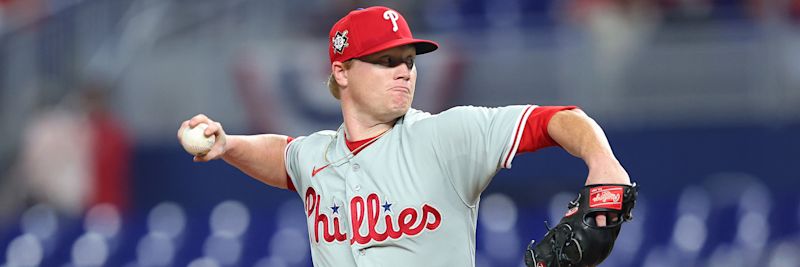
Nelson has gone under 4.5 strikeouts in 67% of his career starts across three full seasons. He's a ground-ball oriented, contact-inducing right-hander who profiles around a 19-21% strikeout rate and averages just 3.9 K per outing. Tonight at Chase Field against Atlanta, 90 starts of data say the under is the play.


There are two types of starting pitchers in Major League Baseball. There are the strikeout artists who rack up double-digit whiffs and leave hitters flailing at air. And then there are pitchers like Ryne Nelson, who make their living by getting hitters to put the ball in play on the ground, inducing weak contact, and letting the defense do the work behind them. Nelson is emphatically the latter, and that distinction is everything when it comes to betting his strikeout props.
Nelson profiles as a classic contact pitcher. His career strikeout rate hovers in the 19-21% range, which puts him well below the league average for starting pitchers. He doesn't overpower hitters with elite velocity. He doesn't generate swing-and-miss with a devastating breaking ball. What he does is locate his sinker and changeup to keep hitters off balance, induce ground balls, and work efficiently through innings without needing to punch guys out. It's a perfectly viable way to pitch in the big leagues. It's just not the profile of a guy who's going to fan five or more hitters on a regular basis.
Nelson's approach is built on contact, not whiffs. His sinker-changeup combination generates ground balls and soft contact rather than swings and misses. Across 90 career starts over three seasons, he's averaged just 3.9 strikeouts per outing with a median of 4. That median number is critical: it tells you that in a typical Nelson start, he's landing right at or below 4.5 strikeouts. His entire pitching identity works against the over here.
When you bet a strikeout prop, you're betting on the pitcher's ability to miss bats. Nelson simply doesn't miss bats at a rate that supports clearing 4.5 consistently. His fastball sits in the low-to-mid 90s without the kind of ride or extension that generates whiffs up in the zone. His slider and changeup are effective for getting hitters to roll over or chase down, but they aren't the elite swing-and-miss secondaries you see from pitchers whose K props you'd want to go over on. Everything about Nelson's arsenal is designed to produce outs through contact, not through the K column.
This isn't a knock on Nelson as a pitcher. It's an honest assessment of his profile. And it's exactly what makes his under props so consistently profitable over a massive sample.
The beauty of this play is the sample size. We're not relying on a two-week hot streak or a handful of cherry-picked starts. This is three full seasons of data, encompassing 90 starts across varying lineups, ballparks, and game situations. And the story those 90 starts tell is remarkably consistent.
| Season | Starts | Under 4.5 K | Under Rate | Avg K/Start |
|---|---|---|---|---|
| 2023 | 29 | 22 | 76% | 3.3 |
| 2024 | 28 | 16 | 57% | 4.5 |
| 2025 | 33 | 22 | 67% | 4.0 |
| Combined | 90 | 60 | 67% | 3.9 |
Look at those numbers. In 2023, Nelson went under 4.5 strikeouts in 76% of his starts, averaging just 3.3 K per game. That's the floor, and it's spectacular for under bettors. In 2024, the under rate dipped to 57%, his worst year, but even then the under was still hitting at a rate that would be profitable at standard juice. And in 2025, he settled right back into his comfort zone at 67% with a 4.0 K average.
The combined line is the one that matters most: 60 unders in 90 starts. That's a 67% hit rate on this prop across a massive sample. When you're getting -125 juice on a prop that hits 67% of the time, you're printing money. The breakeven at -125 is roughly 55.6%. Nelson's under clears that threshold by more than 11 percentage points. That's not a marginal edge. That's a gaping one.
The distribution chart tells an even more compelling story. Nelson's most common K totals are clustered between 0 and 4. The overwhelming majority of his starts, about two thirds, land at 4 or fewer strikeouts. When he does go over 4.5, it's typically by a narrow margin, hitting 5 K far more often than he hits 7 or 8. The outlier starts where he racks up 7 or more strikeouts are genuinely rare, occurring in roughly 9% of his career outings. This is a pitcher whose ceiling on any given night is much more likely to be 5 than it is to be 8.
In the world of player props, sample size is everything. Anyone can find a trend over 10 starts. Anyone can cherry-pick a two-month stretch where a pitcher ran hot or cold on strikeouts. But when you have 90 starts spread across three complete seasons, you're looking at something that transcends variance and noise. You're looking at a pitcher's true identity.
90 starts is an enormous sample for a strikeout prop bet. Most sharp bettors consider anything above 30 starts to be a reliable dataset. Nelson gives us three times that. His 67% under rate isn't a small-sample quirk or a hot streak. It's who he is as a pitcher. His sinker-changeup approach, his velocity band, his ground-ball orientation, all of it points to a guy who simply does not strike out enough hitters to consistently clear 4.5. That's not changing tonight against the Braves.
Here's what makes Nelson's profile so bankable for under bettors: consistency across contexts. His under rate was strong in 2023 when he was still relatively new to the rotation. It dipped in 2024 but still stayed above breakeven. And it bounced right back in 2025 as he settled into his role. This isn't a pitcher who had one great year and then regressed. This is a pitcher who has shown a stable, reliable tendency to come in under this number regardless of the specific opponent, ballpark, or game situation.
Think about all the variables that changed across those 90 starts. Different lineups, different umpires, different game scripts, home and away, day and night, hot weather and cold. Through all of it, Nelson kept landing under 4.5 K in two out of every three starts. That kind of consistency across varying conditions is the strongest possible signal that you're looking at a real, exploitable tendency rather than random noise.
His 2026 opener offers a small window into this season's version of Nelson: 4 strikeouts in 4.2 innings against Oakland, with a rough 7.71 ERA. He didn't dominate. He didn't overpower anyone. He got four K's, which is right in line with his career norms and, conveniently, below the 4.5 line. One start is meaningless on its own, but it confirms that nothing about Nelson's approach has fundamentally changed heading into 2026.
Does the Atlanta Braves lineup matter here? Of course it does. The Braves are a talented offense with legitimate power and the ability to work counts. But here's the thing: they're not the kind of lineup that dramatically tilts a strikeout prop in either direction for a pitcher like Nelson.
Atlanta's offensive identity is built around contact-quality hitters who put the ball in play. They have guys who can go deep, but they also have veteran bats who shorten up with two strikes and spray the ball to all fields. This isn't the Angels lineup from a few nights ago that strikes out 27% of the time. The Braves are a professional, well-rounded lineup that will make Nelson work, but they're not going to gift him a bunch of swings and misses just because they're aggressive.
Nelson has faced the Braves three times in his career with wildly mixed results: 7 K in 2024, 0 K in 2023, and 5 K in 2023. That's a tiny, noisy sample that tells us almost nothing. The 7 K outing looks scary, but a single start against any opponent is statistical noise. The 0 K outing is equally meaningless in the other direction. With only three data points, we should lean on the 90-start career sample rather than three head-to-head matchups. The career numbers are the signal. The head-to-head splits are the noise.
The more relevant question is whether the Braves' lineup profile systematically increases or decreases a pitcher's strikeout potential. And the answer, for a contact pitcher like Nelson, is that it doesn't move the needle much. Nelson isn't going to suddenly become a strikeout pitcher because he's facing a good lineup. Good lineups can actually suppress a contact pitcher's K rate because they put more balls in play rather than chasing outside the zone. Nelson's sinker is designed to generate weak contact, and the Braves are a team that's going to make contact. That combination doesn't produce a ton of strikeouts.
If anything, the home environment at Chase Field is a mild positive for the under. Nelson is comfortable on his home mound, and the warm Arizona air doesn't generate the kind of movement that leads to more swing-and-miss. This is a pitch-to-contact environment for a pitch-to-contact pitcher.
No prop play is a lock, and there are legitimate reasons to be cautious here. Let's walk through the risks honestly.
These are real concerns, and they're why we're playing this at 1 unit rather than 3. But the 90-start sample at 67% overwhelms the noise. Even accounting for the Braves' quality and Nelson's occasional ceiling games, the base rate is simply too strong to ignore at this price.
This is a textbook under play backed by an enormous sample size. Ryne Nelson has gone under 4.5 strikeouts in 60 of his 90 career starts, a 67% rate that has held steady across three full seasons, different opponents, and varying game conditions. He's a contact pitcher to his core. His sinker-changeup combination generates ground balls and weak contact rather than whiffs. His career average of 3.9 K per start and median of 4 mean he's consistently landing right at or below this number.
At -125 odds, you need this prop to hit roughly 55.6% of the time to break even. Nelson's career under 4.5 K rate of 67% gives you an 11+ percentage point edge over breakeven. That's a significant, data-backed advantage grounded in 90 starts of evidence. The Braves lineup doesn't change Nelson's fundamental identity as a contact pitcher, and the Chase Field environment is neutral to mildly favorable for the under. This is one of those rare spots where the data is so overwhelming that the play almost makes itself.
Nelson doesn't need to have a great game for this to cash. He doesn't need to dominate the Braves or spin a gem. He just needs to be himself: a ground-ball pitcher who induces contact, works efficiently, and doesn't pile up strikeouts. That's what he's done in two thirds of his career starts, and there's no reason to expect tonight to be any different. Lock in the under.