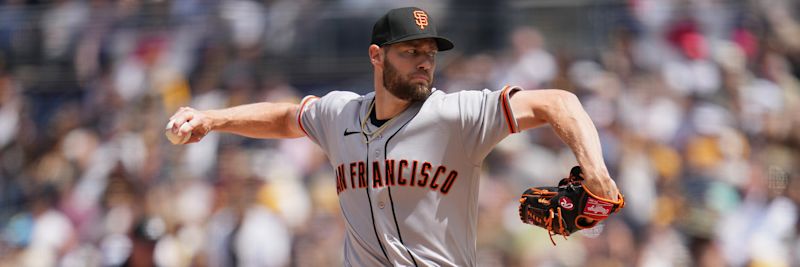
Houser's career 7.1 K/9 tells you who he is, but the real story is in the year-by-year trend. He's posted a K/9 under 7.0 in four of his last five seasons, and his sinker-heavy approach generates ground balls, not whiffs. At +108 against a contact-oriented Phillies lineup that hit .258 last year, this is the cleanest under on the board tonight.


Adrian Houser is the textbook definition of a contact pitcher. His entire approach on the mound revolves around one simple idea: make hitters put the ball on the ground. His primary pitch is a sinker that he throws roughly 46% of the time, and it does exactly what sinkers are supposed to do. It runs arm-side, drops below the zone, induces weak contact, and generates ground ball after ground ball. It's not a pitch that misses bats. It's a pitch that produces 4-3 putouts and 6-4-3 double plays.
The numbers back this up across his entire career. Houser has a 7.1 career K/9 across 739 innings and 126 starts. That's not a small sample. That's seven years of professional data telling you the same thing: this man does not strike hitters out at a high rate. And here's the part that matters most for tonight's prop. His K/9 has been under 7.0 in four of his last five full seasons. The only outlier was 2023, when he posted a 7.8 K/9 with Milwaukee. Every other year since 2020, he's been a 5.8-to-6.6 K/9 pitcher. That's his true talent level. That's who he is.
Houser's sinker-first approach is fundamentally incompatible with high strikeout totals. When you throw a pitch designed to generate ground contact nearly half the time, you're actively choosing outs-on-contact over swings-and-misses. His 2025 combined line across Chicago and Tampa Bay tells the story: 125 innings, 92 strikeouts, 6.6 K/9. He averaged roughly 4.4 K per start. The under at 3.5 strikeouts isn't a gamble on a bad night. It's a bet on a pitcher doing exactly what he always does.
The signing tells you everything San Francisco thinks about Houser. They gave him a 2-year, $22 million deal in December 2025 because they wanted innings, durability, and ground balls. They didn't sign him to punch guys out. They signed him because his sinker keeps the ball on the ground, limits hard contact, and lets Oracle Park's spacious outfield do the rest. The Giants know exactly what they're getting: a 200-inning innings eater who pitches to contact. That's not a criticism. It's his job description.
The year-by-year numbers are the single most important piece of evidence for this prop. Let's look at every season of Houser's career and see the pattern for ourselves.
| Season | Team | IP | K | K/9 | Role |
|---|---|---|---|---|---|
| 2019 | MIL | 35.1 | 37 | 9.5 | Mixed (RP/SP) |
| 2020 | MIL | 56.1 | 44 | 7.1 | Starter |
| 2021 | MIL | 142.1 | 104 | 6.6 | Starter |
| 2022 | MIL | 111.1 | 74 | 6.0 | Starter |
| 2023 | MIL | 133.0 | 115 | 7.8 | Starter |
| 2024 | MIL | 136.0 | 88 | 5.8 | Starter |
| 2025 | CWS/TB | 125.0 | 92 | 6.6 | Starter |
| 2026 | SF | 5.1 | 4 | 6.8 | Starter |
The pattern is unmistakable. Strip out the 2019 outlier, which came in just 35 innings with significant relief usage, and you're looking at a pitcher who has been a 5.8-to-7.1 K/9 starter in six of his seven full seasons. The one exception was 2023 at 7.8, and even that is barely above average for a starting pitcher. In his two most recent full seasons (2024 and 2025), he posted a 5.8 and 6.6 K/9, respectively. The trend line isn't just flat. It's tilted downward. Houser is getting fewer strikeouts as he ages, not more, because he's leaning more heavily into his sinker and ground ball approach.
Houser's 9.5 K/9 in 2019 is the number that inflates his career average. But context matters: that was a 35.1 inning sample split between relief and starting duties. Relief pitchers naturally post higher K/9 numbers because they throw max effort for one or two innings. Once Houser became a full-time starter in 2020, he's never posted a K/9 above 7.8. His true K/9 as a starter, across over 700 innings, is closer to 6.5 than the 7.1 career number suggests.
This is the kind of data that makes prop betting profitable. The sportsbook is pricing this prop partly based on Houser's career 7.1 K/9, which includes that bloated 2019 relief sample. But if you look at his recent track record as a full-time starter, the 6.0-6.6 K/9 range is his actual baseline. At a 6.3 K/9, a pitcher averaging 5.5-6.0 innings per start would expect roughly 3.8-4.2 strikeouts per game. That puts 3.5 right at the knife's edge, and the sportsbook is giving you plus money to bet the under. That's a pricing gap you can exploit.
If the K/9 trend tells you Houser doesn't miss bats, the ground ball data tells you why. This is a pitcher whose sinker was literally one of the best pitches in baseball by run value during his peak seasons. His approach isn't just "low strikeouts." It's "intentionally designed to produce ground balls at an elite rate."
In 2021, Houser posted a 59.0% ground ball rate. That ranked 2nd in all of Major League Baseball among qualified starters. Think about that for a moment. Out of roughly 150 pitchers who threw enough innings to qualify, Adrian Houser had the second-highest ground ball rate in the sport. Six out of every ten balls in play against him bounced on the dirt. That's not an accident. That's a man throwing a sinker 46% of the time with the explicit goal of keeping everything below the knees.
Even as Houser's ground ball rate has come down from its 2021 peak, it remains elite. His 48.9% GB rate in 2025 ranked in the 79th percentile league-wide. That means he still generates ground balls at a higher rate than nearly 4 out of 5 pitchers in baseball. When hitters are pounding the ball into the dirt, they're not striking out. Ground ball pitchers and high-strikeout pitchers are fundamentally different species, and Houser is about as pure a ground ball pitcher as you'll find in the majors today.
Here's the mechanical explanation. Houser's sinker sits in the low-90s and features heavy arm-side run with natural sinking action. When a hitter swings at a pitch that's dropping below the barrel of the bat, one of two things happens: they miss completely (uncommon, because the pitch is in the zone, not off the plate), or they get on top of it and hit a weak grounder. The sinker is designed to generate contact, not whiffs. It's why his swinging strike rate has consistently been below the MLB average. Hitters make contact against Houser. They just don't make hard contact, and they certainly don't lift the ball. That's the sinkerball pitcher's contract with the universe: I'll let you hit it, but you're going to hit it into the ground.
His sinker was ranked as the 3rd-best pitch by run value during his Milwaukee years, and the reason is simple. It generates more outs per pitch than almost any offering in baseball, precisely because it induces contact rather than chasing it. You don't need to strike everyone out when 49% of the balls put in play against you are bouncing toward the shortstop.
Philadelphia is not the lineup you want to face if you're trying to rack up strikeouts. The 2025 Phillies posted a .258 team batting average, which ranked 3rd in all of MLB. That's a lineup full of professional hitters who put the bat on the ball. They don't chase, they don't expand, and they don't gift pitchers easy swinging strikes on breaking balls in the dirt.
Their team strikeout rate of approximately 21.7% puts them squarely in the middle of the pack. They're not the hardest lineup to strike out in baseball, but they're nowhere near the easy targets that some pitchers feast on. The key for tonight's prop isn't just the raw K rate. It's the type of offense the Phillies run. This is a team built around making contact, working counts, and putting balls in play. They have hitters at every position who shorten up with two strikes and focus on putting the barrel on the ball.
When a sinkerball pitcher with a career 7.1 K/9 faces a contact-oriented lineup that hit .258 last year, the strikeout expectation compresses downward. Houser isn't going to overpower this lineup. He's going to throw sinkers, they're going to make contact, and the at-bats are going to end on ground balls and line drives rather than strikeouts. The Phillies' offensive identity actively works against high K totals from pitchers like Houser who don't have put-away secondary stuff.
Consider the chain of events that leads to a strikeout. The pitcher needs to get ahead in the count, then execute a chase pitch or a swing-and-miss offering to finish the at-bat. Houser's approach is the opposite: he throws strikes, gets ahead, and then throws another strike. The Phillies' hitters are going to swing at those strikes. They're going to make contact. The ball is going to be in play. That's how Houser works, and it's how the Phillies hit. The convergence of those two identities points firmly toward the under.
No prop pick is bulletproof. Here are the legitimate risks to consider before taking the under.
These risks are real, but they don't override 700+ innings of career data. Houser has been a 6.0-6.6 K/9 pitcher in four of his last five full seasons. One outlier year (2023) and one debut start don't change a seven-year body of work. The sinker is still his primary pitch. The ground ball rate is still elite. The approach hasn't changed. And the Phillies are a contact lineup that won't gift him easy strikeouts. The profile overwhelms the noise.
This is plus money on one of the most reliable contact-pitcher profiles in baseball. Adrian Houser has made 126 career starts across 739 innings, and his 7.1 career K/9 includes an inflated 2019 relief sample that overstates his true strikeout ability as a starter. Strip that out, and you're looking at a pitcher who has posted a K/9 under 7.0 in four of his last five seasons, with a 5.8 and 6.6 in his two most recent full years.
At +108 odds, you need this prop to hit 48.1% of the time to break even. Houser's sinker-first approach, his 48.9% ground ball rate (79th percentile), and his consistent sub-7.0 K/9 as a full-time starter all point toward a pitcher who lives below 4 strikeouts more often than the market gives him credit for. Tonight's matchup against a Phillies team that hit .258 and plays a contact-heavy style only compresses the K expectation further. You're getting plus money on a sinkerball pitcher doing what sinkerball pitchers do: inducing weak contact instead of racking up K's.
Houser doesn't need to be bad tonight for this to cash. He doesn't need to get knocked around or pulled early. He just needs to be himself: a sinker-throwing, ground-ball-generating, contact-inducing starter who gets outs without punching hitters out. That's been his identity for seven years. It was his identity in his 2026 debut. And at plus money against a lineup that puts the ball in play, it's the sharpest strikeout under on tonight's slate.