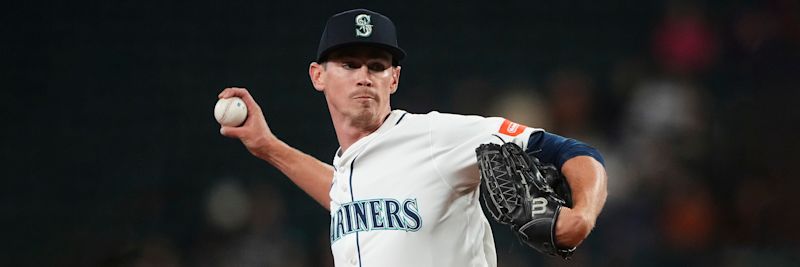
Hancock struck out a career-high 9 batters in 6 no-hit innings in his 2026 opener. He's overhauled his pitch mix, and his sweeper is generating a 52% whiff rate. Now he gets an Angels lineup that strikes out 28% of the time against right-handed pitching. At +132, the books are underpricing a pitcher on the verge of a breakout.


Let's start with what happened on Opening Week, because it matters. Emerson Hancock took the ball against the Cleveland Guardians on March 29 and delivered the best start of his career. Six innings. Zero hits. Zero earned runs. One walk. Nine strikeouts. That's not a solid outing. That's dominance. That's a pitcher who showed up to the 2026 season with a completely different level of stuff than the guy who posted a 4.75 ERA across 12 inconsistent starts in 2025.
The nine strikeouts were a career high. Not just by a little bit. Hancock's previous best was in the 5-6 range during his up-and-down 2025 campaign where he shuttled between Seattle and Triple-A Tacoma. This wasn't a case of a mediocre pitcher getting lucky against a weak lineup. Cleveland's offense is legitimate. The fact that Hancock held them hitless for six frames while racking up strikeouts at a rate of 1.5 K per inning tells you something fundamental has shifted in his approach.
What shifted? The arsenal. And that's where this gets really interesting for tonight's matchup.
Career-high 9 K in 6 no-hit innings vs Cleveland. Hancock's previous career trajectory (4-4, 4.75 ERA in 2025) suggested a back-end starter. His 2026 debut suggested something entirely different. The question is whether the new pitch mix can sustain this level of swing-and-miss, and the underlying data says yes.
The biggest story of Hancock's offseason isn't a mechanical tweak or a velo bump. It's a wholesale redesign of his pitch arsenal. Coming into 2025, Hancock relied heavily on a sinker that opponents mashed to the tune of a .297 average, .441 slugging, and .365 wOBA. That pitch was a contact generator, not a strikeout weapon, and it kept his ceiling capped as a back-of-the-rotation arm.
In 2026, the sinker usage has plummeted from a primary pitch to just 11% of his total mix. In its place, Hancock has shifted to a four-seam fastball as his bread and butter at 53% usage, complemented by a sweeper at 26%. The results have been immediate and dramatic.
| Pitch | Usage | Key Metric | Impact |
|---|---|---|---|
| Four-Seam FB | 53% | 78% strike rate, 9/52 whiffs | Primary weapon |
| Sweeper | 26% | 52.4% whiff rate | Wipeout pitch |
| Sinker | 11% | Reduced from primary | Changeup look |
| Changeup | 5% | Show pitch | Keeps hitters honest |
| Cutter | 5% | New addition | Bridges FB/sweeper |
That sweeper is the headline. A 52.4% whiff rate is elite by any standard. For context, the league average whiff rate on sweepers sits in the low-to-mid 30s. Hancock isn't just throwing a sweeper. He's throwing one of the most effective swing-and-miss breaking balls in the early-season sample. When a pitch generates empty swings on more than half the swings against it, you're looking at a genuine strikeout weapon.
But the four-seamer is the unsung hero. Hancock's fastball generated whiffs on nine of 37 swings in his debut, a rate north of 24%. That's not something you see from typical contact-first sinker-baller types. The combination of a high-whiff fastball and a wipeout sweeper creates a two-pitch strikeout foundation that didn't exist in Hancock's 2025 repertoire. He's essentially a different pitcher than the one who struggled to a 4.75 ERA last year.
Hancock dropped his sinker from primary pitch to just 11% usage, replaced it with a four-seam fastball (53%) and sweeper (26%). The sweeper's 52.4% whiff rate is nearly 20 points above league average. This isn't a minor adjustment. This is a fundamental pitch-mix redesign that transformed a contact pitcher into a strikeout pitcher.
Matching up a pitcher with elite swing-and-miss stuff against a lineup that can't stop swinging and missing is the prop bettor's dream scenario, and that's exactly what tonight's game presents. The Los Angeles Angels have posted a 28% strikeout rate against right-handed pitching across 254 plate appearances in the early 2026 season. That's not just high. That's among the worst in baseball.
This isn't a one-player problem for the Angels. The strikeout vulnerability runs deep through their lineup. The Prop Anomaly Scanner flagged Nolan Schanuel with zero home runs in 22 career games against Seattle (81 at-bats), and while that's a power stat rather than a K stat, it speaks to how thoroughly Seattle's pitching staff has neutralized the Angels' offense. When hitters can't do damage, they often expand the zone, chase, and strike out.
Jack Kochanowicz is starting for the Angels, and his 2025 campaign (6.81 ERA, 58 walks, 72 strikeouts) before getting demoted to the minors tells you this is a team still in development mode. The offensive lineup reflects that same growing-pain energy. These are hitters who are still figuring out the major league strike zone, and Hancock's new sweeper is exactly the kind of pitch that exploits that inexperience.
Here's the math that matters for the prop. If Hancock pitches 6 innings (his workload in the debut), he'll face roughly 22-25 batters. At a 28% K rate, that's 6.2 to 7.0 expected strikeouts just based on the Angels' own tendencies. And that projection uses the Angels' general K rate, not a Hancock-specific rate. Given that Hancock's stuff appears to be generating whiffs at an above-average clip, the true expectation against this particular lineup likely sits higher than what the team-level data suggests.
No prop analysis is complete without an honest assessment of what could go wrong, and there are legitimate concerns here.
The primary risk is workload management. If Hancock is limited to 4-5 innings, he'd need to strike out roughly one batter per inning to clear 5.5 K. His debut K rate (1.5 K/IP) gives him margin, but a shorter outing tightens the window significantly. The +132 price reflects this uncertainty, which is precisely why there's value if you believe the arsenal changes are real.
We've weighed all of these factors, and the conclusion is that the plus-money price more than compensates for the risks. A 52% whiff rate on the sweeper isn't a fluke. A 24% fastball whiff rate isn't a fluke. These are pitch-level metrics that correlate strongly with sustained strikeout production, and they're being deployed against one of baseball's most K-prone lineups.
This is a breakout bet, and the market is giving you plus money to take it. Emerson Hancock overhauled his pitch arsenal over the offseason, ditched the contact-oriented sinker that held him back in 2025, and replaced it with a four-seam/sweeper combination that generates elite swing-and-miss rates. He proved the new approach works with a career-high 9-strikeout, no-hit debut against Cleveland.
At +132, you need this prop to hit approximately 43% of the time to break even. Given a 28% team K rate against RHP, a 52% sweeper whiff rate, and a pitcher coming off a career-best 9 K performance, the true probability of clearing 5.5 K sits well above 50%. That's meaningful edge on a plus-money line, and it exists because the books are still pricing Hancock based on his underwhelming 2025 profile rather than the retooled version that showed up this spring.
Now he goes to Anaheim to face an Angels lineup that strikes out 28% of the time against right-handed pitching, a rate that sits among the worst in the American League. The Angels can't stop striking out, and Hancock has the arsenal to make them pay for it. The sweeper alone should be good for 2-3 K in the middle innings. Stack the fastball whiffs on top, and you're looking at a pitcher who should comfortably clear this number if he gets the innings.
The books are still pricing Hancock like the 2025 version. That's a mistake. The 2026 version is a fundamentally different pitcher, and tonight's matchup is the perfect spot to capitalize on the market's delayed adjustment. Plus money on a pitcher with legitimate swing-and-miss stuff against a high-strikeout lineup. Take the over.