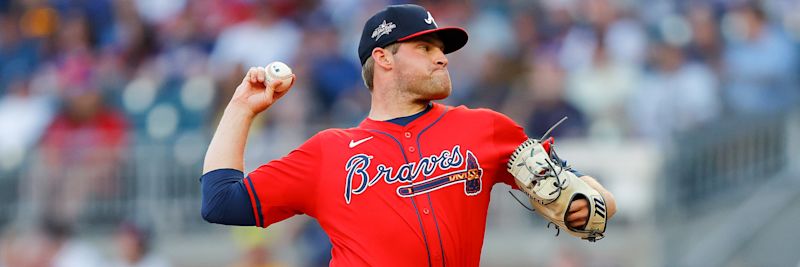
Elder's late-season breakout carried real strikeout gains into 2026, and now he faces an Oakland lineup that has fanned 50 times in just three games to start the year. The A's are swinging out of their shoes with nothing to show for it. Over 4.5 K's at -128 is a clean spot.


Bryce Elder is not a name that jumps off the page when you think about strikeout pitchers. He was never the guy racking up 10-K outings or making highlight reels with 98 mph heaters. But something changed in September 2025, and the numbers tell a very clear story. Elder pushed his strikeout rate above 25% down the stretch, a significant jump from his earlier-season rates, and it wasn't a fluke. He made mechanical adjustments to his pitch mix that generated more swings and misses on his secondary stuff, and those gains appear to be carrying into the new season.
A 25%+ strikeout rate in September represents a real developmental leap for Elder. This wasn't a small-sample blip against September call-up lineups. Elder was facing playoff-contending teams during that stretch and still generating whiffs at an elevated clip. When a pitcher's K rate jumps that much in the final month of a season, it often signals a legitimate mechanical or pitch-mix improvement rather than random variance.
But the strikeout gains are only half the story. What makes Elder such an attractive strikeout prop target is his workload. He pitched at least six innings in 9 of his last 11 starts during the 2025 season. That's a workhorse pitcher who doesn't get pulled after five innings. He goes deep into games, which means more batters faced, more two-strike counts, and more opportunities to pile up strikeouts. A pitcher who averages 6+ innings per start has a built-in advantage on K props simply because he's out there longer than the average starter.
Think about what 6+ innings means for a 4.5 K prop. If Elder faces 24-26 batters over six innings, he only needs to strike out roughly 18-19% of them to clear 4.5. With a September K rate above 25%, he's projecting well above that baseline even on an average day. The math is extremely favorable when you combine an improved strikeout profile with a pitcher who consistently logs enough innings to give himself every chance to cash the over.
| Stat | Value | Context |
|---|---|---|
| Sept K Rate | 25%+ | Career-high strikeout rate in final month |
| 6+ IP Starts | 9 of 11 | Consistent workhorse, goes deep in games |
| Pitch Mix | Adjusted | More secondary usage driving whiff gains |
| Innings Tendency | 6+ regularly | More batters faced = more K opportunities |
Here's where this play goes from good to great. The Oakland Athletics have struck out 50 times against Blue Jays starters in their first three games of 2026. Fifty. In three games. That is an absolutely staggering number that tells you everything about what this lineup is right now. They are swinging for the fences on every pitch, chasing breaking balls out of the zone, and making zero adjustments at the plate.
50 strikeouts in 3 games works out to nearly 17 K's per game against starting pitching alone. That's not a lineup that's battling and fouling off tough pitches. That's a lineup that's expanding the zone, swinging through fastballs, and getting completely overwhelmed by anything with movement. When you see that kind of volume, it's a lineup-wide approach problem, not bad luck.
The A's are 0-3 to start the season, and their losing streak isn't just about the pitching they've faced. It's about the quality of contact they're making, or more accurately, the complete absence of quality contact. Oakland's "swing for the fences" mentality has turned them into a strikeout machine for opposing pitchers. They're not working counts. They're not shortening up with two strikes. They're loading up and hacking, and when you do that against competent pitching, you whiff. A lot.
This matters for Elder specifically because his pitch mix is built to exploit exactly this kind of approach. He's not going to overpower anyone with velocity, but he throws strikes and forces hitters to put the ball in play or go down swinging. Against a lineup that's choosing to swing aggressively rather than take a disciplined approach, Elder's stuff is going to generate swings and misses that he wouldn't get against a patient, contact-oriented lineup. Oakland's aggressive plate approach is a gift for any pitcher with halfway decent secondary stuff, and Elder's September breakout proved his secondaries are more than halfway decent.
It's also worth noting the competitive context. Oakland is an 0-3 team with a roster that knows it's rebuilding. There's a real question about whether this lineup will tighten up its approach or continue pressing. History tells us that rebuilding teams with young, aggressive lineups tend to keep striking out at high rates throughout the season. There's no veteran presence in that dugout telling guys to shorten up and put the ball in play. The K numbers are likely to stay elevated.
4.5 strikeouts. Let that number sit for a second. The books are asking us to decide whether Bryce Elder will strike out five or more batters against a lineup that's averaging nearly 17 K's per game. Even accounting for the fact that not all of those strikeouts come against the starting pitcher, the baseline expectation for any competent arm facing this Oakland team is already hovering around 5-6 K's just based on the opponent's approach.
Look at Elder's alternate strikeout lines for confirmation that the books know this number is low. Over 6.5 K is available at +132, which means the market sees a realistic path to 7 strikeouts. Over 7.5 K is out there at +350, a longshot but not a moonshot. When the alternate lines are juiced that aggressively, it tells you the base over 4.5 is priced as a high-probability outcome. We agree with that assessment.
The -128 odds on over 4.5 reflect the books' understanding that this is a favorable matchup, but we think they're still underpricing the probability. Here's the math: at -128, you need this to hit approximately 56% of the time to break even. Given Elder's improved K rate, his workhorse tendencies, and Oakland's historically bad early-season plate discipline, we're projecting the true probability closer to 65-68%. That's a meaningful edge.
Elder pitching at home adds another layer. Truist Park is a pitcher-friendly environment, and home-field starters tend to get the benefit of the doubt on borderline calls. When you're a pitcher who attacks the zone and forces swings, getting an extra strike call here and there creates more two-strike counts. More two-strike counts against a free-swinging lineup means more chances to put guys away. Everything about this matchup points in the same direction.
If you're feeling ambitious, the 6+ K line at +132 is worth a look as a secondary play. Elder going six innings against this lineup projects to roughly 6-7 K's based on the K rate and opponent tendencies. Getting plus money on a number that sits right in the middle of his projection range is solid value. The 7+ K line at +350 is a true flier, but if Elder gets into the seventh inning against this group, it's not out of the question.
Let's be honest about the risks here, because no play is a lock:
We've considered all of these factors and still believe this is a positive-expectation play. The 4.5 line is set low enough that Elder's baseline projection clears it comfortably, and the matchup-specific tailwinds push the probability even higher. The risks are real but unlikely to all materialize simultaneously.
At -128, the break-even is 56.1%. We project Elder's probability of clearing 4.5 strikeouts at 63-67% against this Oakland lineup, giving us a clear edge of 7-11%. Elder's improved K rate, workhorse innings that put him in front of 24+ batters per start, and an Athletics team that is fanning at a historic pace early in 2026 all converge on the same conclusion. The 4.5 line is set too low for this matchup, and the price isn't steep enough to reflect how favorable the spot really is. This is a high-confidence play with a meaningful mathematical edge.
Everything lines up here: pitcher improvement, opponent vulnerability, home-field advantage, and a line that underestimates the true probability. When you get that kind of alignment, you play it.