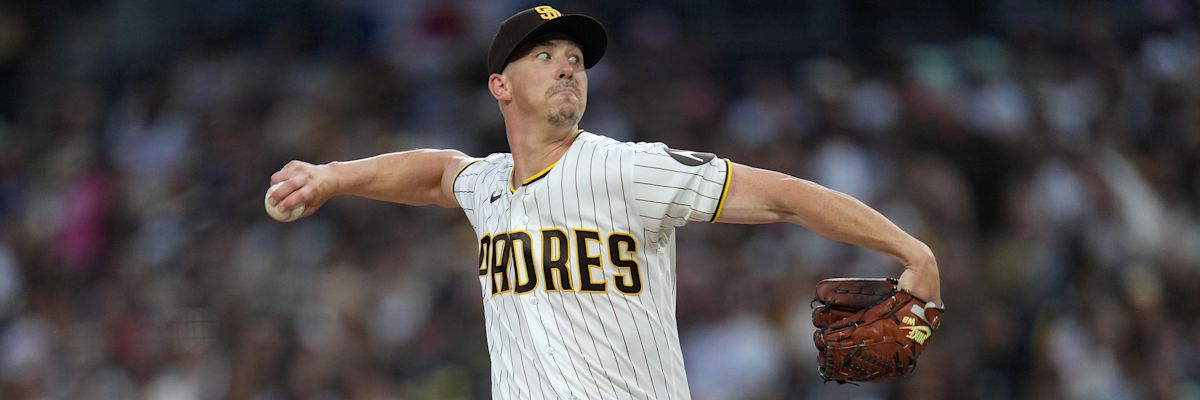
Walker Buehler has finished under 4.5 strikeouts in 22 of his last 26 starts. That is an 84.6 percent under rate on the exact line the market is asking you to beat tonight. Over his last five outings his K totals have been 4, 2, 3, 3, and 2, an average of 2.8 strikeouts per start. His 2026 ERA sits at 9.45 with a 16.6 percent strikeout rate and a 14th percentile whiff rate. The juice at -146 is heavy, but the underlying profile is overwhelming, and the Rockies are the wrong lineup to chase strikeout upside against.


Walker Buehler is listed at 4.5 strikeouts on DraftKings with the under at -146 for the Padres versus Rockies matchup at Petco Park on April 10 2026, first pitch 9:40 p.m. Eastern. The market has set Buehler as a pitcher who projects to reach roughly half a strikeout above four on a standard outing. Nothing in his recent profile supports that line, and the historical base rate at this specific number is one of the most lopsided you will find in the pitcher prop market.
Across his last 26 starts Buehler has finished under 4.5 strikeouts in 22 of them. That is 84.6 percent. If you were building a model from scratch and applied nothing beyond that base rate, fair odds on the under would sit near -550. DraftKings is offering -146. The question is not whether the number is aggressive. The question is why the book still thinks Buehler has the ceiling to reach the over often enough to justify the line at all.
| Metric | Value | Why It Matters |
|---|---|---|
| Career Under 4.5 K Rate | 22 of 26 (84.6%) | Elite historical under hit rate at this exact line |
| Career K/Start Average | 3.5 | An entire strikeout below the 4.5 line on average |
| Last 5 Starts K Totals | 4, 2, 3, 3, 2 | Four of the last five games finished under 4.5 |
| Last 10 K Average | 2.9 | The trend has gotten worse, not better |
| 2026 ERA | 9.45 | Limited length means limited strikeout volume |
| 2026 K Rate | 16.6% | Well below the 22% league baseline |
The most important context for this bet is that the Walker Buehler throwing in 2026 is not the Buehler who anchored postseason Dodgers rotations. Multiple elbow surgeries and a long rehab road took away much of the premium strikeout upside that used to define him. The fastball that used to ride at 96 has lost velocity. The curveball that used to be a true putaway weapon now generates soft contact more than swinging strikes. The whole profile has shifted from dominant ace to contact-managing back-end rotation arm, and the raw numbers confirm it.
Buehler is now a pitcher who survives through sequencing and weak contact, not through strikeouts. His 2026 ERA sits at 9.45, which tells you he has been getting hit, but the layer underneath the ERA is the real story for a strikeout bet. A 16.6 percent strikeout rate in a league that averages around 22 percent means he is not generating whiffs at anywhere near the rate needed to clear a 4.5 line on a regular basis. His whiff rate is in the 14th percentile. That is not a guy who misses bats. That is a guy who tries to survive innings.
Even on his good nights, the pattern holds. His last five starts produced 4, 2, 3, 3, and 2 strikeouts. That is 14 total punchouts across five appearances, an average of 2.8 per outing, and not a single game in which he cleared four strikeouts. The market line is asking him to do something he has not done a single time in his most recent sample.
The other half of this wager is the Colorado lineup. Rockies hitters have historically been one of the tougher strikeout matchups in the National League because their offensive philosophy leans on contact, ball in play outcomes, and extending at-bats rather than selling out for power. That is exactly the type of approach that kills pitcher K totals even on nights when the pitcher is throwing well. A hitter who spoils a two-strike pitch and grounds out to second is the worst possible outcome for an over bettor and the best possible outcome for an under bettor.
Colorado is not a team that gives away free strikeouts. Their team strikeout rate runs below the MLB average, and they bring a number of veteran bats that specifically pride themselves on putting the ball in play. When you pair a contact-friendly lineup with a pitcher whose primary skill is now contact management rather than bat missing, the projected strikeout total collapses fast. This is the textbook matchup where 4.5 is the wrong side.
Note the structural gap. Buehler needs to outperform his own current strikeout rate by roughly eight percentage points to reliably cash an over on a 4.5 line in a typical 24 to 25 batter outing. That is not a normal night for him right now. That is an outlier outing that requires everything to break his direction at once.
Strikeout props are fundamentally volume dependent. If a pitcher does not face enough batters, he cannot rack up strikeouts even when he is throwing well. Buehler's 2026 ERA of 9.45 is a giant red flag for length. Pitchers with ERAs that high do not get past the fifth inning on a regular basis, and they often exit in the fourth or even the third when the outing gets away from them early. Every out he does not get is an at-bat he cannot convert into a strikeout.
If Buehler faces 20 batters at a 16.6% K rate, he projects to 3.3 strikeouts. If he faces 22 batters, he projects to 3.7 strikeouts. Even at 24 batters, the projection lands right at 4.0. In order for the over to win, Buehler needs both length he has not been getting and a strikeout rate he has not been showing. Asking a struggling pitcher to suddenly start going deeper into games at an elevated K pace is asking for a double shift in his profile. The path to the under is the path of least resistance.
The last five starts back this up. When a pitcher is giving up runs early, managers go get him. Short hook, short outing, few strikeouts. That is the rhythm Buehler has been stuck in, and there is nothing in his 2026 profile that suggests it flips tonight against a contact-first Colorado lineup in a game the Padres need to win.
Heavy juice is a fair concern on any pitcher prop. A price of -146 implies a breakeven point near 59.3 percent. For most strikeout lines that number would give you pause, but this specific ticket is one of the rare cases where the base rate alone clears it by a wide margin. The historical under rate at 4.5 for Buehler is 84.6 percent. The last five starts sit at 80 percent. Even the last ten are running well above the breakeven. You have multiple independent samples all pointing to the same conclusion.
Add in the opponent profile, the stuff decline, the length concern, and the below-average 2026 strikeout rate, and you are stacking edges on top of a base rate that was already dominant. The juice does not erase the value. It only narrows it. The under still prices out as a positive expected value bet by a clear margin.
The risk is a sudden bounce back outing where Buehler finds his old velocity and the Rockies happen to chase pitches out of the zone. That can happen in any single game. The point of prop betting is not to be right every time. It is to take the side with the right math over the long run. This is that side.
Walker Buehler under 4.5 strikeouts at -146 is one of the strongest base rate plays of the day. The 22 of 26 career hit rate at this line is not a cherry-picked sample. It is the majority of his starts. The 2.8 K average over his last five outings is not a small dip. It is a trend. The 16.6 percent 2026 strikeout rate is not a noisy early season reading. It is the new profile of a pitcher whose bat-missing ceiling has been permanently diminished by elbow injuries.
Pair that profile with a Colorado lineup built to put the ball in play and you are not asking for Buehler to struggle. You are asking him to keep being what he has been: a contact-heavy, short-outing starter who rarely sees a fifth strikeout in a box score. That is the entire bet. Take the under. Take the juice. Move on.