Eighteen point nine one percent. Of the 3,554 times a Tampa Bay Ray has come to the plate this season, only 672 of those trips have ended with a called or swinging third strike. No lineup in baseball makes contact more often. The league as a whole strikes out in 22.10 percent of its plate appearances, and the Rays are running more than three full points beneath it while hitting .259 as a team, the kind of profile that turns a starter's afternoon into a grind of six-pitch at-bats and soft singles instead of a highlight reel.
Now put Jake Bennett in front of them. Bennett has been very good this year, 4-3 with a 2.64 ERA and a 0.94 WHIP over 8 starts, and none of that has come from missing bats. His strikeout rate is 6.61 per nine, and the arsenal explains why in a single line: he throws a four-seam fastball 33.6 percent of the time and a sinker 27.6 percent, and a breaking ball, sweeper and curveball combined, on 9.9 percent of his pitches. Under ten percent. A pitcher who almost never spins one, against a lineup that almost never swings through one.
That is the entire idea, and the market has it at +128.
A Strikeout Prop Is An Innings Prop Wearing A Costume
Here is the thing the strikeout market gets wrong more often than any other number on the board. Everyone prices the stuff. Almost nobody prices the leash. A pitcher does not get to a strikeout total with his slider, he gets there with batters faced, and batters faced is a manager's decision as much as a pitcher's. Every one of the four leans our July 17 board produced is really a question about how long a man stays on the mound, and once you look at it that way three of the four stop being about strikeouts at all.
Bennett is the clean version of the idea. He is a genuine starter, 8 starts out of 8 appearances, 5.81 innings per outing, no ambiguity about his role. But he is throwing Game 1 of a split doubleheader that exists because of a May 9 postponement, on the first day back from the All-Star break, which means Boston carries a 27th man and a fully rested bullpen that has not worked since July 12. Nothing about that afternoon encourages a long leash. Bennett has faced 22 or 23 hitters in each of his two starts against Tampa Bay this season and struck out 1 and 4. Trim even a hitter or two off that and the Under gets easier, not harder.
Read that chart honestly and it cuts both ways. It is a gift to the Bennett Under and it is a problem for the two other Unders on our board, because Detmers and Miles are both facing lineups that strike out more than the league average, not less. We are not going to pretend otherwise further down the page.
Jake Bennett: The Arsenal Is The Argument
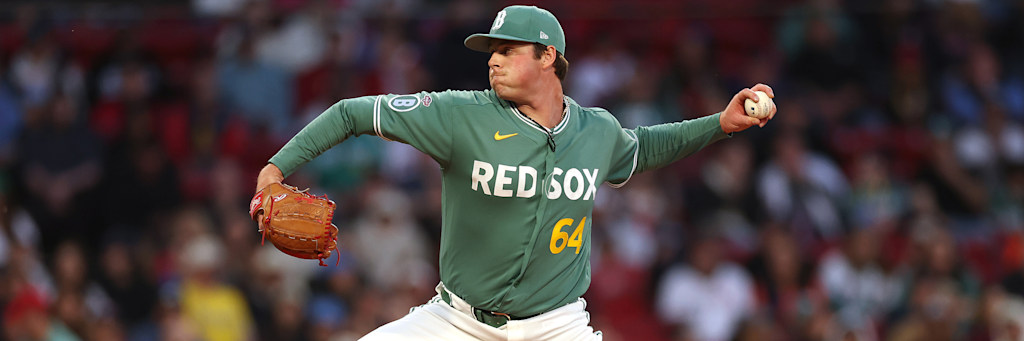
Bennett's season is a quietly excellent one that nobody outside New England has noticed: a 2.64 ERA, a 0.94 WHIP, 8 walks in 47.2 innings, opponents hitting .219 against him. He has been worth watching. He has not been worth betting overs on. In 8 starts he has recorded 35 strikeouts, and the way he gets his outs is the reason. The four-seamer sits 93.0 and he throws it a third of the time. The sinker sits 92.6 and gets another 27.6 percent. His actual out pitch is a changeup at 83.6, thrown 25.6 percent of the time, a 9.4 mile per hour separation off the heater that generates weak contact more than empty swings. Everything else, the sweeper at 79.5 and the curveball at 79.2, adds up to one pitch in ten.
That is a pitcher built to induce ground balls and short at-bats, and it works. It just does not produce strikeout totals, and against this specific opponent it produces even fewer. Bennett has already met Tampa Bay twice. On May 7 he went 5.1 innings, faced 22 hitters and struck out exactly 1. On June 10 he went 5.0 innings, faced 23 and struck out 4. Ten and a third innings, 5 strikeouts, a 4.35 per nine rate against a season figure of 6.61. Two starts is a small sample and we will treat it as one, but it points the same direction as the arsenal and the same direction as Tampa Bay's league-low whiff rate. When three independent things agree, that is usually the read.
The Honest Counterpoint, And It Is A Real One
If this page only showed you the Rays' strikeout rate and Bennett's pitch mix, it would be selling you something. So here is the number that argues against the lean, stated as plainly as the ones that argue for it: Jake Bennett has gone over 3.5 strikeouts in 5 of his 8 starts. The Under has hit 3 times out of 8. That is 37.5 percent, and the +128 price needs 43.9 percent to break even. On his raw season record alone, this bet loses money.
It gets worse before it gets better. On June 22 he struck out 9 Colorado hitters in 6 innings, the loudest outing of his year, proof that the ceiling is not theoretical. He has cleared this number in five of his last six. And the line is set at 3.5 precisely because the books know his average is 4.38, which means the Under is asking him to finish below his own norm rather than merely near it.
So why lean it anyway? Because the 8-start record treats every opponent as the same opponent, and they are not. Bennett's 9-strikeout game came against Colorado. His 6 came against the Angels, who strike out at a 24.99 percent clip, the highest rate in baseball. His 4 came against the White Sox, a 23.73 percent lineup. Against the three lowest-strikeout lineups he has faced all year he has averaged 3.3 punchouts. Against everyone else, 5.0. The season mean of 4.38 is a blend of those two very different pitchers, and today he is the first one.
The counterexample deserves its moment, because it exists and it is inconvenient. On June 17 he struck out 5 Blue Jays, and Toronto sits 29th in strikeout rate at 19.62 percent, nearly as contact-oriented as Tampa Bay. One start does not break a pattern, but it does prove Bennett can find five swings and misses against a lineup that theoretically should not give them up. The matchup tilts this bet. It does not decide it. If you do not believe an opponent can move a starter a full strikeout off his mean, there is no version of this lean you should take.
The Rest Of The July 17 Board: Three More Leans, Ranked Honestly
Our model ran 26 strikeout contracts across the slate this morning and cleared 4. Every one is tagged a lean, which is the weakest tier we publish, and none of them belong in a parlay. Here they are with the thing most props pages leave out, which is what each pitcher's own record says versus what the price demands.
| Lean | Line & Price | Break-Even | His Own Record | Verdict |
|---|---|---|---|---|
| Jake Bennett (BOS) vs Rays | Under 3.5, +128 | 43.9% | Under hit 3 of 8 (37.5%) | Record says no, matchup says yes. Featured lean. |
| Reid Detmers (LAA) vs Tigers | Under 6.5, +100 | 50.0% | Under hit 11 of 19 (57.9%) | The only one where record and model agree. Plus money. |
| Spencer Miles (TOR) vs White Sox | Under 4.5, -170 | 63.0% | Under hit 3 of 3 starts | Structurally right, badly priced. Tiny sample. |
| Griffin Jax (TB) vs Red Sox | Over 4.5, -148 | 59.7% | Over hit 7 of 14 (50.0%) | Weakest of the four. His record is under the bar. |
Reid Detmers, Under 6.5 at even money, is the play on this board with the least to apologize for. He has made 19 starts, the largest sample of the four by a distance, and the Under has landed in 11 of them, 57.9 percent. Our model independently lands within a tenth of a point of that figure, and the price asks for 50 percent flat. When a 19-start record and a model built from pitch-level data arrive at the same number and the book is offering even money, that is worth writing down. The counterpoint is genuine and it is the matchup: Detroit strikes out at 23.23 percent, eighth most in baseball, and Detmers is a 10.19 strikeouts per nine arm who punched out 14 Rangers over 8 innings on May 24. But his leash has been shrinking, 5.0 innings on July 3 and 4.0 on July 9, and a 6.5 line is only reachable if he is out there into the sixth.
Spencer Miles, Under 4.5 at -170, needs a disclosure before anything else: he is not really a starter. He has 26 appearances and 3 starts, 60 innings total, which is 2.31 innings per outing and 3.33 per start. Toronto is using him as a bulk arm and today he happens to have the ball first. His last start, July 7 against San Francisco, was 4.0 innings and 1 strikeout. Across all three of his starts he has 5 strikeouts total. The Under is almost structurally guaranteed by his role, and he throws a sinker 40.5 percent of the time at 96.1 with a changeup he has thrown twice all season, a two-pitch relief profile that does not turn a lineup over three times. So why is this not the featured lean? Because -170 makes you lay nearly two to one on a three-start sample against the sixth most strikeout-prone lineup in the league. The read is right and the price already knows it.
Griffin Jax, Over 4.5 at -148, is where we part ways with our own model, and we would rather say that out loud than bury it. The model likes this one most confidently of the four. His record does not support it. Jax has 14 starts, 61 strikeouts in those starts, an average of 4.36, which is below the 4.5 line he needs to clear. He has gone over in exactly 7 of 14, a 50 percent rate against a price demanding 59.7 percent. He averages 4.31 innings per start because he spent the first part of this season in the bullpen and Tampa Bay is still stretching him out. He did strike out 10 Yankees on July 6 and his sweeper, thrown 26.0 percent of the time at 88.0 off a 96.2 four-seamer he only uses 17.9 percent of the time, is a legitimate bat-misser. But he faces a Boston lineup at a middling 21.95 percent strikeout rate, in Game 1 of a doubleheader, at 4.3 innings a start. We are printing the model's lean because that is what the board produced. We are also telling you it is the one we would drop first.
Where We Are Passing: NRFI, YRFI, And Pitcher Outs
There is no first-inning play on this page today, and that is worth explaining rather than hiding at the bottom. Our July 17 board evaluated 26 contracts. Every single one of them was a pitcher strikeout market. Not one first-inning run contract and not one pitcher outs contract made it onto the board to be priced at all, which means there is no NRFI lean, no YRFI lean, and no outs lean to give you.
The temptation on a day like this is to reverse-engineer one, to look at the slate, find two decent arms and write four hundred words about why their first inning is safe. We are not doing that. A first-inning play that our model never priced is not analysis, it is decoration. This page has run a first-inning pick on most days this month because the board produced one. Today it did not. Four strikeout leans out of 26 contracts is a thin, ordinary day, and thin ordinary days are the majority of days in this market. Anyone telling you otherwise every single morning is not modeling, they are filling space.
How To Approach It
- The featured lean: Jake Bennett Under 3.5 strikeouts at +128, Game 1 at Fenway Park, 1:35 ET.
- The case: Tampa Bay's 18.91 percent strikeout rate is the lowest in baseball, Bennett throws breaking balls on 9.9 percent of his pitches, and he has 5 strikeouts in 10.1 innings against these Rays.
- The break-even: +128 needs 43.9 percent, the friendliest bar on the board, which is why a matchup read is playable here at all.
- The risk: Bennett averages 4.38 strikeouts per start and the Under has hit in only 3 of 8. His raw record does not clear the bar. The matchup has to carry it.
- The best-supported alternative: Reid Detmers Under 6.5 at +100, where a 19-start record and the model both sit near 58 percent against a 50 percent price.
- The one to skip: Griffin Jax Over 4.5 at -148. His own average is below his line and his record is nearly ten points under the break-even.
- Sizing: lean tier, small. Four thin edges on a 26-contract day is not a green light, it is a Friday.
Final Verdict
The Rays put the ball in play more than anyone alive, Jake Bennett does not miss bats, and the two of them meet at 1:35 in the afternoon in a makeup game nobody planned for. That is the whole page. Bennett's 2.64 ERA is real and his 0.94 WHIP is real and neither of them has anything to do with strikeouts, because he throws a four-seamer, a sinker and a changeup and lets hitters get themselves out. Against a lineup striking out three full points below league average, in a doubleheader opener with a rested bullpen behind him, the Under 3.5 at +128 is the shape of bet worth taking at a price that only needs 43.9 percent. It is also a bet that his own 8-start record says loses, which is why it is a lean and why it is sized like one. If you want the number where everything agrees instead of the one where the matchup has to win an argument, Detmers Under 6.5 at even money is sitting right there. Four leans, 26 contracts, no first-inning play, and no pretending today is bigger than it is.
FAQ
The lean is Jake Bennett Under 3.5 strikeouts at +128 in Game 1 of the split doubleheader between the Tampa Bay Rays and Boston Red Sox at Fenway Park, first pitch 1:35 PM ET. Bennett is 4-3 with a 2.64 ERA over 8 starts and 47.2 innings, but his 6.61 strikeouts per nine is a contact profile, not a swing-and-miss profile. Tampa Bay strikes out in 18.91 percent of its plate appearances, the lowest rate of any lineup in baseball. In two starts against the Rays this season Bennett has 5 strikeouts across 10.1 innings. This is a lean and it is priced as one, not a lock.
Because a strikeout prop is decided by the hitters as much as the pitcher. Tampa Bay's 18.91 percent strikeout rate is the lowest among all 30 teams and sits well under the 22.10 percent league average, and the Rays hit .259 as a team, meaning they put the ball in play and keep innings moving. Bennett's arsenal is built the same way from the other side: he throws a four-seam fastball 33.6 percent of the time and a sinker 27.6 percent, with a breaking ball on only 9.9 percent of his pitches. A pitcher who does not throw breaking balls against a lineup that does not chase is the structural shape of a low strikeout total.
The risk is Bennett's own record. He averages 4.38 strikeouts per start and has gone over 3.5 in 5 of his 8 starts, so the Under has hit only 37.5 percent of the time, which is below the 43.9 percent break-even the +128 price requires. The entire case rests on the Rays matchup rather than on Bennett's season form, and he punched out 9 Colorado hitters on June 22 to prove the ceiling exists. If the read on Tampa Bay is wrong, the raw record says this loses.
No. The July 17 model board evaluated 26 contracts and every one of them was a pitcher strikeout market. No first-inning run contract and no pitcher outs contract cleared onto the board at all, so there is no NRFI or YRFI lean to report today. We are documenting that as a pass rather than manufacturing a first-inning play the model never priced.